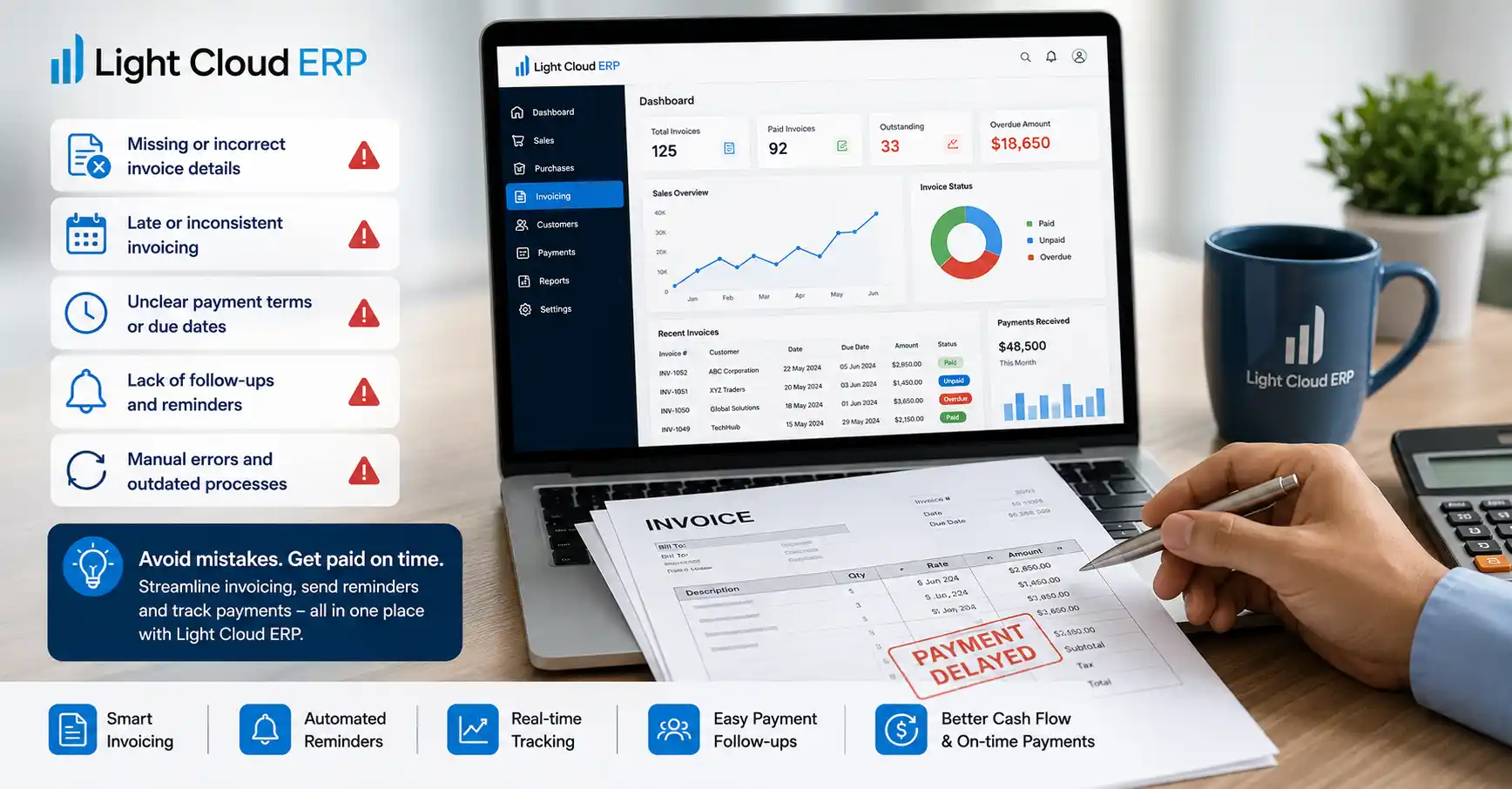
Are you struggling to recover your business cash from clients on time? Unpaid bills damage your working capital and stall growth. Common invoicing mistakes that delay payments include sending bills to the wrong client contact, omitting strict calendar due dates, and failing to include required Purchase Order (PO) numbers. Furthermore, missing itemized descriptions and a lack of clear, multiple payment options significantly prolong your cash flow pipelines. This expert guide reviews these costly billing blunders. We share practical solutions using LightCloud ERP to automate your financial tracking. Our local system speeds up payouts to your customers across Pakistan.
Overview of Invoicing Challenges in Pakistan
Pakistani businesses often rely on manual spreadsheets or paper bills. This traditional method increases data entry errors significantly. When an invoice contains a single typo, your client pushes it away. Corporate clients in Karachi, Lahore, and Islamabad follow strict audit rules. They will not process faulty documents. Transitioning to a secure cloud platform removes these daily friction points.
Common Invoicing Mistakes That Delay Customer Payments
Missing Valid Purchase Order Numbers
Many large corporate buyers require a valid PO number before releasing any payment. If your finance team omits this reference, the client's system rejects your document. Always secure the official purchase order code from your customer upfront. Place this code prominently at the top-right corner of your billing document.
Sending Invoices to Wrong Billing Contacts
Do you send your bills directly to the on-site project manager? This is a massive mistake that delays your payout. Project managers do not clear financial dues; the specialized accounting department does. Identify the correct billing contacts during your contract sign-up phase. Forward your commercial files straight to the designated finance team inbox.
Writing Vague Service Item Descriptions
Vague labels like "services rendered" or "goods delivered" cause instant confusion. If your client cannot understand the breakdown, they will block the approval chain. Create clear line items for every single product or service. Specify exact quantities, verified weights, unit prices, and applied discounts openly.
Omitting Precise Calendar Due Dates
Using standard terms like "Net 30" or "Payable upon receipt" creates room for delay. Clients interpret vague words loosely and postpone your transaction. Write absolute calendar due dates on every billing file. For example, state "Payment Deadline: August 15, 2026" to drive urgency.
Providing Limited Customer Payment Methods
Accepting only physical cross-cheques creates immense friction. Your team loses precious days waiting for courier delivery and clearing cycles. Offer flexible payment methods on your billing layout. Include secure direct ACH transfers, online credit cards, and local Pakistani digital wallets.
Key Features of Automated Billing Systems
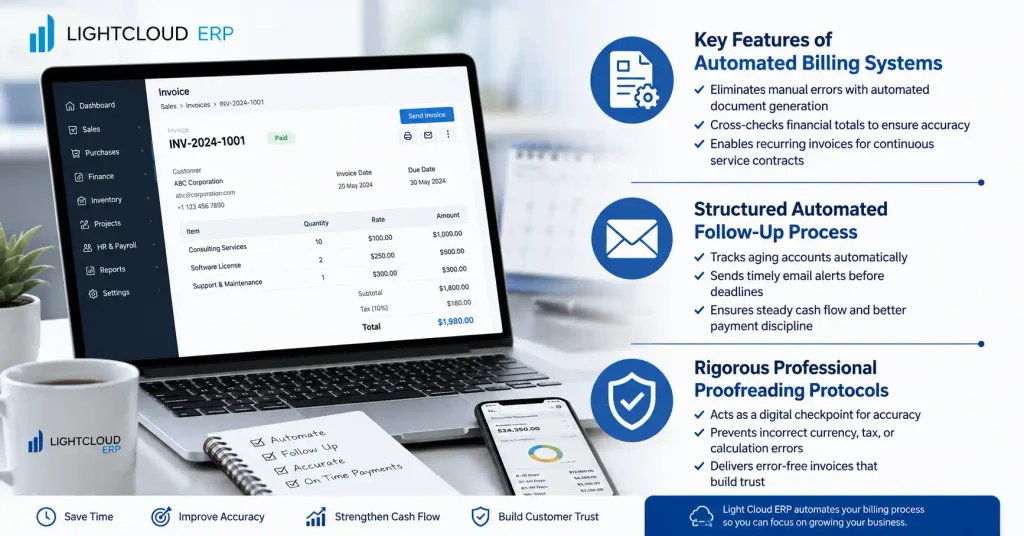
Smart software eliminates manual errors by introducing automated document generation. You can build professional layouts that protect your brand identity. The system cross-checks financial totals automatically to prevent mathematical errors. Digital tools also allow you to deploy recurring invoices for continuous service contracts. This ensures your clients receive their bills on a fixed schedule every month. You can read our detailed guide on expert cloud accounting solutions to modernize your enterprise ledger.
Structured Automated Follow-Up Process
A reliable follow-up process saves you from awkward payment collection calls. The billing tool tracks your aging accounts automatically. It sends polite email alerts to customers before the deadline hits.
Rigorous Professional Proofreading Protocols
An automated platform acts as a digital checkpoint for your finance team. It ensures you never apply an incorrect currency mark or a missing tax rate. Clean documents build stronger commercial trust with enterprise buyers.
Price of ERP Software in Pakistan
Upgrading to an automated business tool is highly affordable for growing local brands. The price of ERP software in Pakistan ranges from 150,000 to 450,000 PKR, depending on the number of user seats. This investment saves your team from costly administrative mistakes. It ensures you recover your outstanding payments much faster.
Latest Modules of LightCloud ERP
LightCloud ERP provides robust tools built specifically for the Pakistani market layout. Our primary billing module handles complex sales tax calculations effortlessly. It keeps your business fully compliant with regional tax documentation laws. The centralized inventory module connects directly with your corporate accounts desk. The system updates your stock ledgers automatically the moment you approve an outbound sales invoice.
Top Types of Invoicing Solutions
Cloud-Based ERP Modules
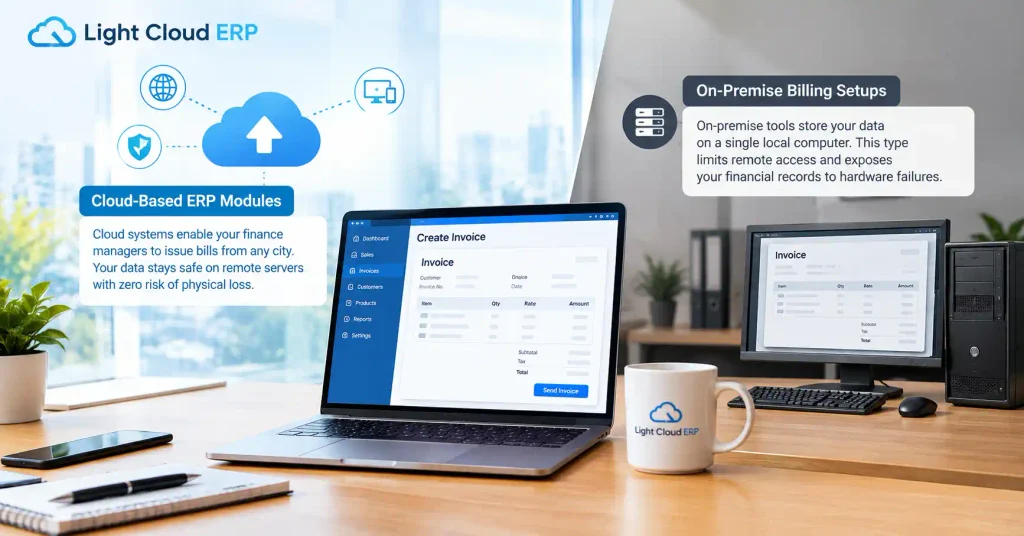
Cloud systems enable your finance managers to issue bills from any city. Your data stays safe on remote servers with zero risk of physical loss.
On-Premises Billing Setups
On-premises tools store your data on a single local computer. This type limits remote access and exposes your financial records to hardware failures.
Popular Brands of Business Management Software
International software applications offer standard configurations for global industries. However, these foreign tools lack native localization for local tax regulations. LightCloud ERP delivers deep custom compliance for Pakistani corporate sectors. Our team provides dedicated local support to keep your operations running smoothly.
Key Things to Consider When Buying ERP Tools
Choose a system that offers clear customization for your credit terms. This gives you firm power over your cash collection cycles. Ensure the system locks data entry fields to stop staff from adding undiscussed fees. Sudden unverified charges frustrate customers and trigger prolonged payment disputes. Explore our expert advice on improving financial workflows to maximize your daily operational efficiency.
Buying Guide for Pakistani Businesses
Map out your operational bottlenecks and required user counts first. Select a business solution provider that offers comprehensive on-site training for your staff. Verify that the platform integrates with reliable local banking interfaces. This helps your customers clear their pending dues through instant mobile transfers.
How to Choose the Right ERP System
Examine the data security protocols of the software provider carefully. Your financial history requires absolute protection from unauthorized access. Select a platform that creates secure automated backup files daily. LightCloud ERP keeps your corporate data safe using encrypted cloud backup protocols.
Conclusion
Fixing the Common Invoicing Mistakes That Delay Customer Payments ensures stable financial health for your business. Eliminate unclear itemizations, update your billing contacts, and enforce clear calendar deadlines. Adopting modern automation secures your hard-earned revenue safely.
Upgrade your business billing system today with LightCloud ERP! Contact our helpful Lahore support desk at +92 3080111822 to launch your system.
Frequently Asked Questions
How can businesses in Pakistan recover delayed customer payments faster from corporate clients?
Businesses can speed up payouts by dropping paper bills and using automated systems to track accounts.
Do manual invoicing errors cause penalties or compliance delays with the FBR?
Yes, small mistakes like incorrect tax calculations or typos lead directly to audit delays and FBR penalties.
What is the average price of automated billing and ERP software in Pakistan?
The price of reliable ERP software generally ranges from 150,000 to 450,000 PKR, depending on your setup.
Why do missing Purchase Order (PO) numbers automatically reject invoices at corporate firms?
Corporate accounts departments require a valid PO number to verify and cross-match approved company purchases safely.
Does LightCloud ERP integrate with local Pakistani bank apps and mobile wallets?
Yes, LightCloud ERP links directly with local banking systems and digital wallets for quick customer payments.
How do vague credit terms like Net 30 disrupt daily business cash flow?
Vague terms allow clients to delay transactions until their next monthly cycle, draining your working capital.